
Your Pineal Gland Is Not a ‘Third Eye’—It’s a Piezoelectric Transducer. Here’s How to Activate It.
Introduction: The ‘Signal’ You’re Missing Is a Hardware Problem
Have you spent months trying to detoxify your pineal gland with supplements and dietary changes, only to feel no different? Are you practicing advanced breathwork, meditating for hours, waiting for a profound signal that never arrives? This common frustration leads many to believe their ‘spiritual hardware’ is permanently bricked.
The problem isn’t a ‘spiritual blockage’ or a flaw in your meditative software. The issue is a degradation of the Signal-to-Noise Ratio in a physical piece of hardware. The key you’ve been missing is a concept from materials science and physics: Pineal Piezoelectric Transduction.
This article deconstructs the pineal gland from a bio-structural engineering perspective. We will move beyond metaphor to explain how this gland functions as a biological transducer composed of micro-crystals. More importantly, we will provide a new, physics-based framework for “Hardware Restoration” to improve its function and finally receive a clear signal. [Link to Internal Blog Post on Biohacking Basics].
Deconstructing the ‘Third Eye’: A Gland of Calcite Microcrystals
It’s time to shift the paradigm. The mystical concept of the ‘Third Eye’ is not just a metaphor; it maps directly onto a biological reality known as biomineralization. The pineal gland is unique not just for its endocrine function, but for its mineral composition.
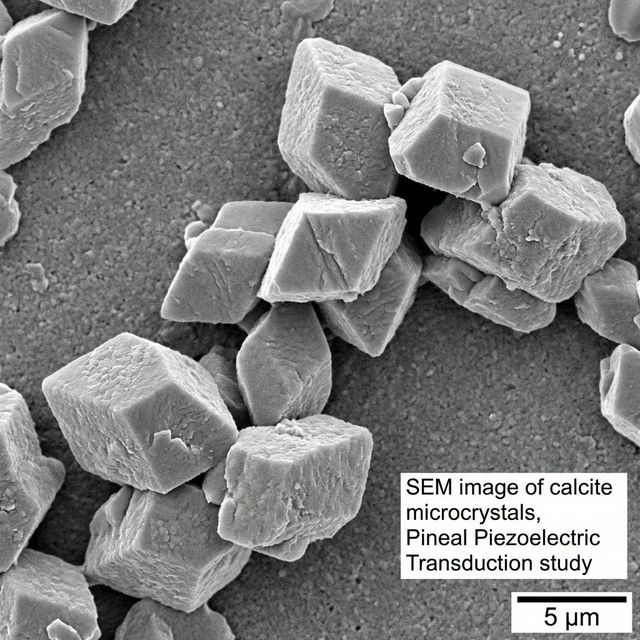
A groundbreaking study by Baconnier et al. identified the presence of calcite microcrystals (a specific form of calcium carbonate) within the human pineal gland. These crystals are incredibly small, typically less than 20 micrometers in length, and exhibit distinct morphologies, including cubic, hexagonal, and cylindrical shapes. These are not the commonly known hydroxyapatite concretions, or ‘brain sand,’ but a separate and more structured form of mineralization.
The significance of this discovery cannot be overstated. Aside from the otoconia in the inner ear, which are critical for balance and sensing gravity, this is the only known non-pathological occurrence of calcite in the human body. This rarity strongly implies that these crystals serve a highly specialized biological function.
From Mineral to Machine: The Science of Pineal Piezoelectric Transduction
To understand the pineal gland’s function, we must first understand a fundamental property of many crystalline materials: piezoelectricity. In simple terms, the piezoelectric effect is the generation of an electric charge in response to applied mechanical stress. Think of the spark mechanism in a BBQ lighter—clicking the button applies mechanical pressure to a crystal, which generates a high-voltage spark. This property, piezoelectricity, is what allows a material to perform electromechanical transduction—the conversion of mechanical energy into electrical energy, or vice versa.
Scientific proof for this property in the pineal gland comes from a study by Lang et al., which used a technique called Second Harmonic Generation (SHG) microscopy. SHG is an optical effect that can only occur in materials with a non-centrosymmetric crystal structure—a necessary condition for piezoelectricity. The study found statistically significant SHG signals in pineal tissue samples but not in control tissues, confirming the presence of these piezoelectric-capable crystals.
This evidence allows us to re-frame the pineal gland as a biological transducer. This electromechanical coupling means the gland is physically equipped to function as a transducer, converting internal mechanical pressures into electrical signals, and potentially as a solid-state antenna capable of interacting with external electromagnetic fields. This process is the core of Pineal Piezoelectric Transduction.
The Driving Force: How Cerebrospinal Fluid Pressure Activates the System
If the pineal crystals require mechanical stress to generate a piezoelectric signal, where does that force come from? The answer lies in the hydrodynamics of the Cerebrospinal Fluid (CSF) that bathes the brain.
CSF flow is not static; it is pulsatile, driven primarily by the rhythmic expansion of cerebral arteries with each heartbeat. However, a more powerful and controllable driver of CSF movement is respiration. Studies by Dreha-Kulaczewski et al. and Vijayakrishnan Nair et al. have demonstrated that changes in intrathoracic pressure from breathing directly influence intracranial pressure, creating waves of movement in the CSF. Deep, forceful breathing creates stronger waves.
This provides a direct physical mechanism for many mystical and meditative experiences. The subjective feeling of energy rising up the spine, often called ‘Kundalini,’ can be understood as the bio-mechanical event of a high-pressure wave of CSF moving up the spinal column. This wave impacts the structures of the third ventricle, including the pineal gland. This impact mechanically stresses the calcite microcrystals, triggering a piezoelectric voltage spike—a powerful electrical signal in the geometric center of the brain. Techniques like the Valsalva maneuver, a core component of Dispenza-style breathwork, are methods to intentionally and dramatically increase this intrathecal pressure, a mechanism detailed in reviews of the Valsalva maneuver’s physiological effects, such as the work by Wostyn et al. on its impact on intracranial pressure.
Signal Failure: Two Reasons Your ‘Antenna’ Is Offline
The persistent failure to “receive the signal” is not a spiritual failing but a hardware issue. It boils down to a poor Signal-to-Noise Ratio, caused by two primary modes of system failure.
Failure Mode 1: Crystal Lattice Impurity
The widespread “Decalcification Anxiety” in spiritual and biohacking communities is partially correct, but it misidentifies the problem. The goal is not to eliminate calcite—the crystals are calcite and are essential to the system’s function. The real concern is the purity of the crystal lattice. Impurities, most notably fluoride, which is known to accumulate in the pineal gland, can integrate into the calcite’s structure. This disrupts the uniform lattice, dampening the crystal’s ability to oscillate cleanly. This is analogous to a flawed crystal radio that can’t tune into a station or a dirty lens that can’t focus light. The signal is still there, but the hardware can no longer resolve it cleanly.
Failure Mode 2: Insufficient Hydraulic Pressure
Even with a perfectly pure crystalline structure, a piezoelectric system produces no signal without mechanical pressure. Modern lifestyles, characterized by shallow, thoracic breathing and sedentary behavior, lead to weak and inconsistent CSF pressure dynamics. There simply isn’t enough hydraulic force being generated to mechanically activate the transducer. This is a power supply problem. Without sufficient pressure to squeeze the crystals, the system remains dormant. It’s like having a perfectly functional device with “not enough voltage” to turn it on.
The ‘Crystal Radio Protocol’: A 3-Phase Approach to Hardware Restoration
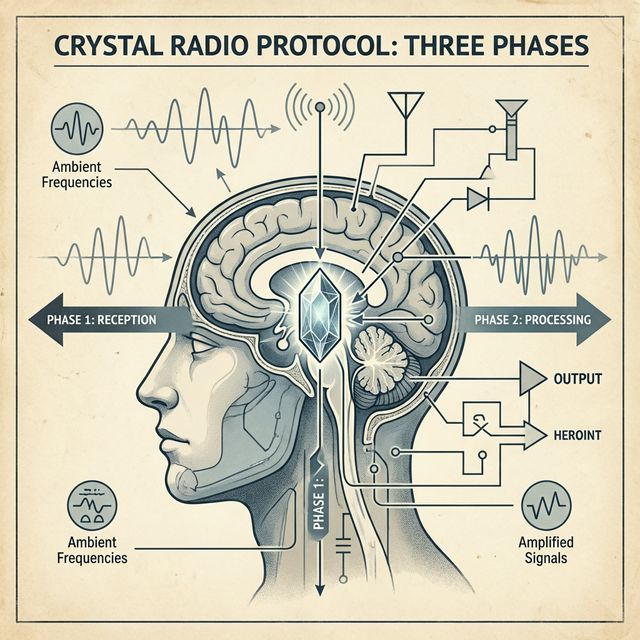
To restore the pineal gland’s function as a transducer, we need a systematic approach that addresses both signal clarity and power supply. The following tri-phasic protocol is designed to clean the components, supply the necessary mechanical energy, and amplify the resulting signal.
Phase 1: Induce Mechanical Stress with Intrathecal Pressure Breathwork
The primary goal is to generate sufficient CSF pressure to mechanically squeeze the pineal’s calcite crystals and trigger a strong piezoelectric effect. This is achieved through breathwork that intentionally elevates intracranial pressure. Dispenza-style breathwork, which incorporates a forceful contraction of core and perineal muscles during a breath-hold (a modified Valsalva maneuver), is designed specifically to push a pressure wave of CSF up the spinal column. This is the “power on” phase of the protocol.
Phase 2: Excite the Crystals with Auditory Entrainment
Every crystalline structure has a natural resonant frequency. When exposed to an external vibration at that frequency, it will begin to vibrate sympathetically, amplifying its energy state. While the specific resonant frequencies of pineal calcite have not yet been determined, we can apply the principle of sympathetic vibration using sound. Applying auditory frequencies known to resonate with mineral structures may induce a sympathetic vibration in the pineal crystals. This auditory entrainment can potentially amplify the piezoelectric effect initiated by the breathwork, essentially “fine-tuning” the receiver for better signal clarity.
Phase 3: Maximize Flow with Targeted Vasodilation
According to poroelastic models of brain fluid dynamics, vasodilation—the widening of cerebral blood vessels—increases the velocity and convective flow of CSF. The objective here is to maximize the speed and force of the CSF pressure wave during the brief window of opportunity created by the intrathecal pressure breathwork. Certain activities (like intense exercise) or supplements can promote systemic vasodilation, increasing the hydraulic efficiency of the breathwork and ensuring the maximum possible mechanical stress is delivered to the pineal transducer.
Conclusion: Rebooting Your Biological Hardware
The paradigm must shift. The pineal gland is not merely a metaphorical ‘eye’ but a functional electromechanical transducer. The path to activating its potential is not found in abstract software commands like visualization alone, but through a tangible process of hardware restoration—improving crystal lattice integrity and applying precise, directed mechanical pressure.
The frustration that so many experience is valid. It stems from attempting to run advanced perceptual applications on degraded biological hardware. This new understanding of Pineal Piezoelectric Transduction provides a coherent, physics-based framework for diagnosing the problem and implementing a solution. By systematically restoring the hardware, you can move beyond frustration and begin to explore the true capabilities of this remarkable biological technology, bridging the gap between ancient wisdom and modern biophysics.