
Human optimization story time.
It was 3:42 AM last Tuesday.
I know the time because the green LED on my wrist flashed against the sheets, lighting up the room like a distress signal. I wasn’t sleeping. I was lying there, staring at the ceiling fan, doing the mental math on my Recovery Score. If I fall asleep right now, I thought, I can still get 4 hours and 12 minutes. That might keep me in the yellow zone.
Then I realized something. Something stupid.
I wasn’t awake because I was stressed about work. I wasn’t awake because I’d had too much caffeine (I cut the coffee at 11 AM, sharp). I was awake because I was performing the act of sleep for an audience of one: an algorithm developed by a 26-year-old engineer in San Francisco who has probably never had a mortgage.
We need to talk about the human optimization data.
Specifically, we need to talk about how we’ve outsourced our own internal sensors to a dashboard.
Human Optimization & The Nocebo Effect of “Readiness”
Here’s a scenario you know. You wake up. The sun is hitting the floorboards. You feel… good. Maybe even great. You stretch, grab your phone, and sync your ring/strap/watch.
Readiness: 34%.
HRV: Tanked.
Sleep Latency: Poor.
And just like that, the energy drains out of you. Your brain says, Oh, wait. My mistake. We’re actually exhausted. You spend the rest of the day dragging your feet, drinking extra espresso, acting out the role of the Tired Person because the app told you to.
This is the nocebo effect—the evil twin of the placebo. And in the biohacking space, it’s becoming a plague.
We aren’t just looking at data anymore; we’re letting it override our own reality.
Human Optimization: The “So What” Layer
I’m not saying the tech is bad. I love the tech. I have a drawer full of dead chargers and straps to prove it. But there’s a difference between observation and dependence.
When we measure everything in human optimization, we stop feeling anything.
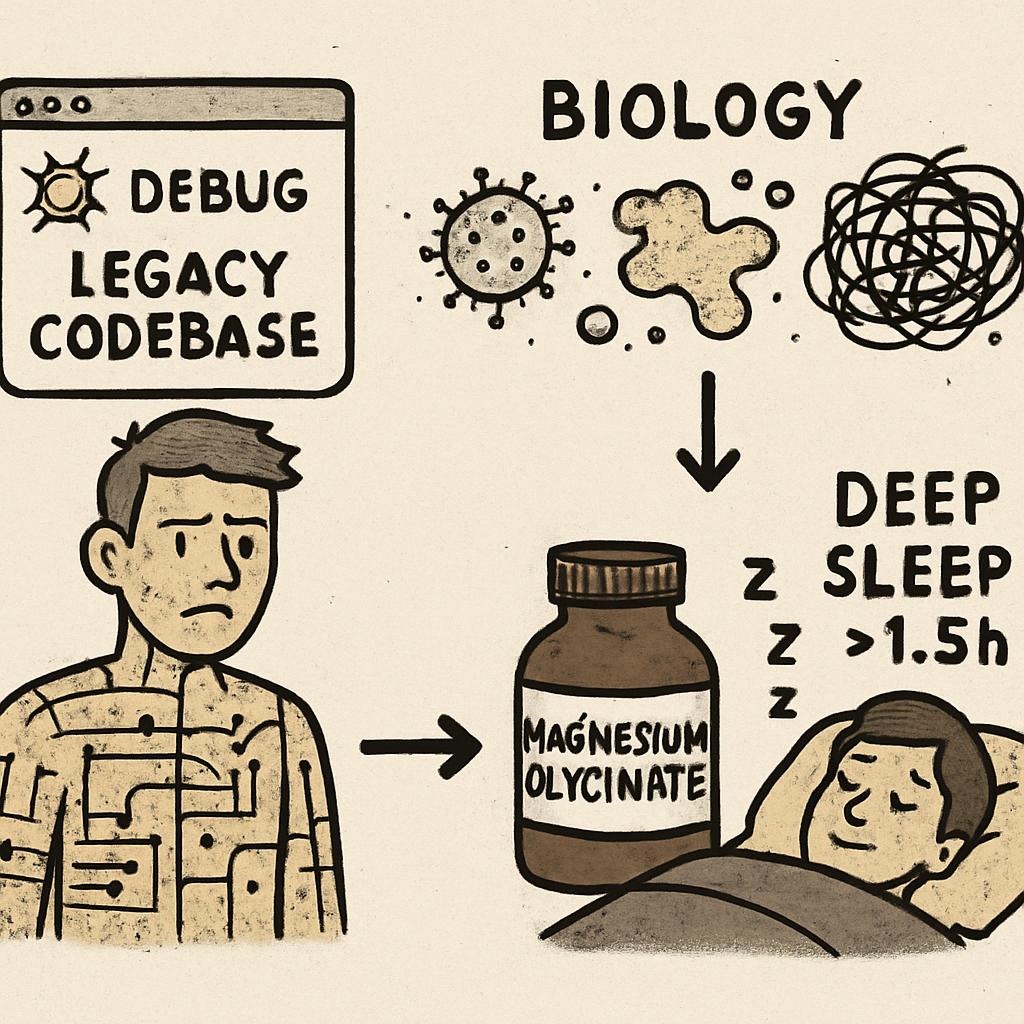
We treat the human body like a legacy codebase that needs to be debugged. If I just tweak this input (magnesium glycinate), I’ll get the desired output (Deep Sleep > 1.5h). But biology is messy. It’s wet. It’s chaotic. It doesn’t run on binary.
Sometimes you sleep like trash because you’re fighting a virus. Sometimes you sleep like trash because you stayed up too late talking to an old friend, and the dopamine hit was worth the cortisol spike.
The algorithm can’t tell the difference. To the watch, that conversation was just “stress.” To you, it was life.
Human Optimization: The Analog Experiment
So, three days ago, I took it off.
The watch. The ring. All of it. I put them in the nightstand drawer—the one that sticks if you don’t pull it exactly straight.
The first night was terrifying. Not functionally—I obviously know how to sleep—but psychologically. How would I know if I recovered? How would I know if my HRV baseline was holding?
I woke up the next morning. I didn’t reach for my phone. I just… sat up.
“How do I feel?” I asked myself.
Groggy, my body said. But the good kind. The kind that shakes off after a shower.
I didn’t have a score to contradict me. I didn’t have a graph telling me I woke up 14 times. I just had the raw, unpolished sensation of being alive.
I went to the gym. I lifted heavy. I didn’t check my strain score. I just lifted until my legs felt like jelly, and then I went home.
Reclaiming Enteroception: Beyond Human Optimization
This isn’t a luddite manifesto. I’m not telling you to throw your Whoop in the river.
But maybe, just maybe, we’ve swung the pendulum too far with human optimization. We’re so obsessed with “optimizing” our biology that we’ve forgotten how to inhabit it. We’re piloting our bodies from the cockpit of a smartphone screen.
Real biohacking isn’t about hitting a high score. It’s about resilience. And you can’t build resilience if you need a battery-powered permission slip to have a good day.
So here’s my challenge to you.
Take a weekend. Take the sensors off. Trust your own hardware—the nervous system that’s been evolving for millions of years. It knows when you’re tired. It knows when you’re hungry. It knows when you’re ready to go.
And it doesn’t need a monthly subscription to tell you.
I could be wrong. Maybe my HRV is crashing right now as I type this. Maybe I’m “undertraining.”
But I feel pretty damn good. And for this week, that’s enough.